
On Substack, many of us indulge in reading or writing gender slop. As with food, tastes vary widely. Some readers may be more into experimental gourmet gender slop and others prefer its fast food equivalent (1, 2). Some prefer their gender slop to be seasoned with subtle second-order political implications, while others would rather have the political message be spoon-fed to them. One particularity of gender slop is that not only do tastes, conclusions and recommendations vary, but also the very basic facts seem completely different. There is almost no common ground: Are women biologically more interested in people than things? Are women actually more into sex than men? Is it aristocratic and eugenic to date BPD art hoes?
My diagnosis is a mixture of things: a) interactions between gender, generation, education, and urban or rural background becoming more important than ever; b) algorithmic bubbles reinforcing existing biases; c) people spending too much time in their basements.
Political incentives push writers and commenters to misrepresent the level of “innate” differences between men and women.1 Since life outcomes seem to vary widely between men and women — especially at the extremes — different “policy-based adjustments” become morally recommendable depending on how much weight is given to the environment. And finally, there is the incentive to write “hot takes”, which more often than not miss the mark.
Whatever is causing this lack of common ground, the current trend suggests that the divide will widen. Therefore, I thought it might be useful to write a “Gender Differences 101”: a basic introduction that is hard to seriously dispute and hopefully useful for evaluating the next viral gender-related hot take.
Another problem is that teenagers often learn about the opposite sex by consuming irresponsible amounts of gender slop and outrage porn. Not all gender slop is incorrect, but even the accurate stuff is often rage-inducing and only covers one small and intricate aspect. Schools are either silent on psychological sex differences or affirm the blank-slatist view. Most people don’t know what neuroticism is and I would bet that a good chunk of people assume men score higher on whatever closely equivalent term they have in mind. If the education system were good, every kid would have seen a few charts of the distributions of Big Five traits by sex before the age of twelve. No one is taking responsibility for teenagers’ education about sex differences, besides maybe telling them to wear condoms.
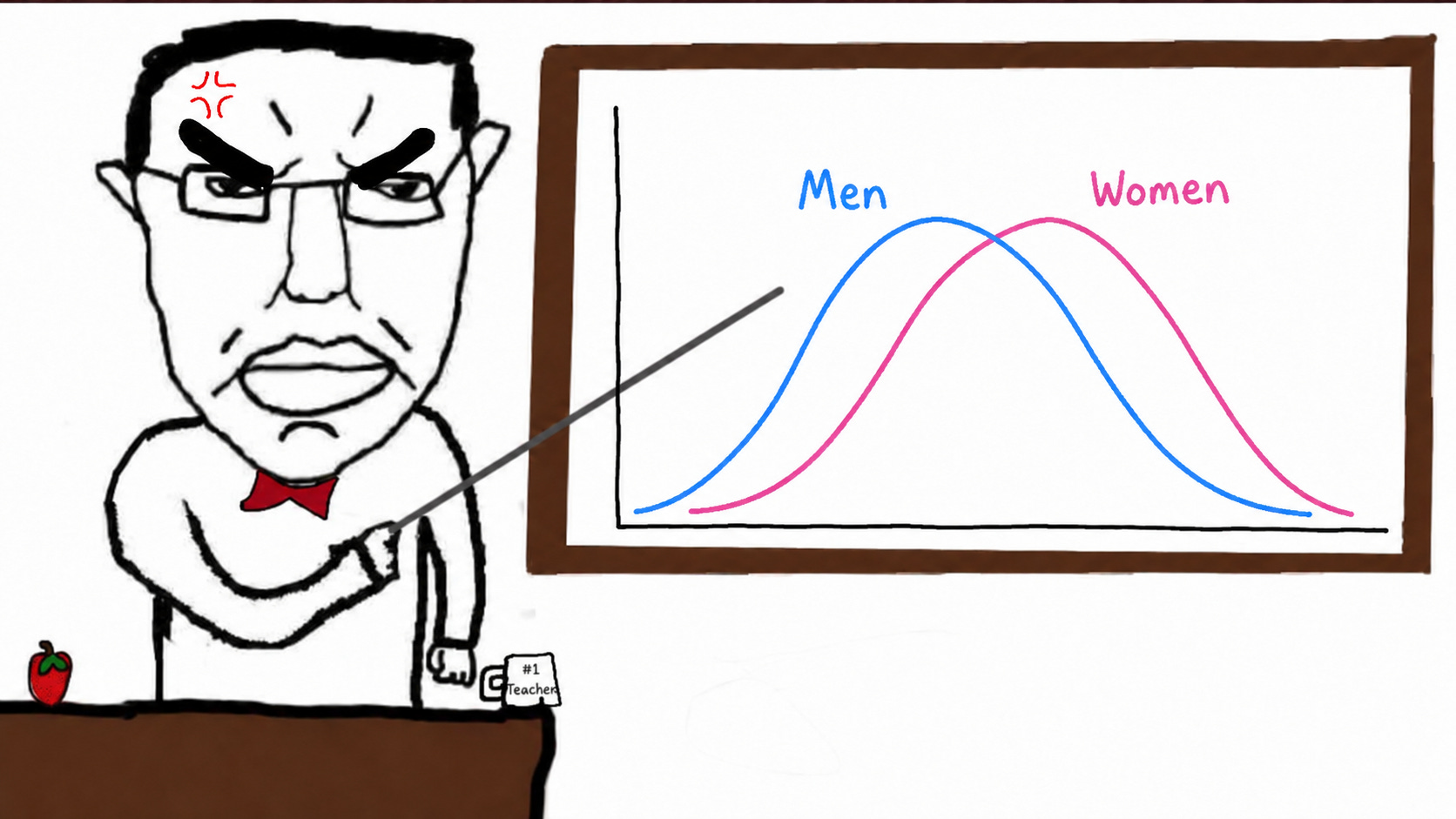
Teaching the basics should help prevent one of the more pathetic human failure modes: becoming terminally gender-war-brained. While being a hateful person is okay, it is still crucial to preserve your intellectual integrity and mental health while doing so! Both of those are at risk in our digital age.
Among men, a terrible affliction is becoming addicted to wasting time watching red-pill influencers DESTROY OnlyFans prostitutes with FACTS AND LOGIC. Women are at risk of becoming addicted to equivalent digital drugs (1, 2, 3). Despite looking tamer, the female versions appear to be more effective at inducing negative views of the opposite sex.
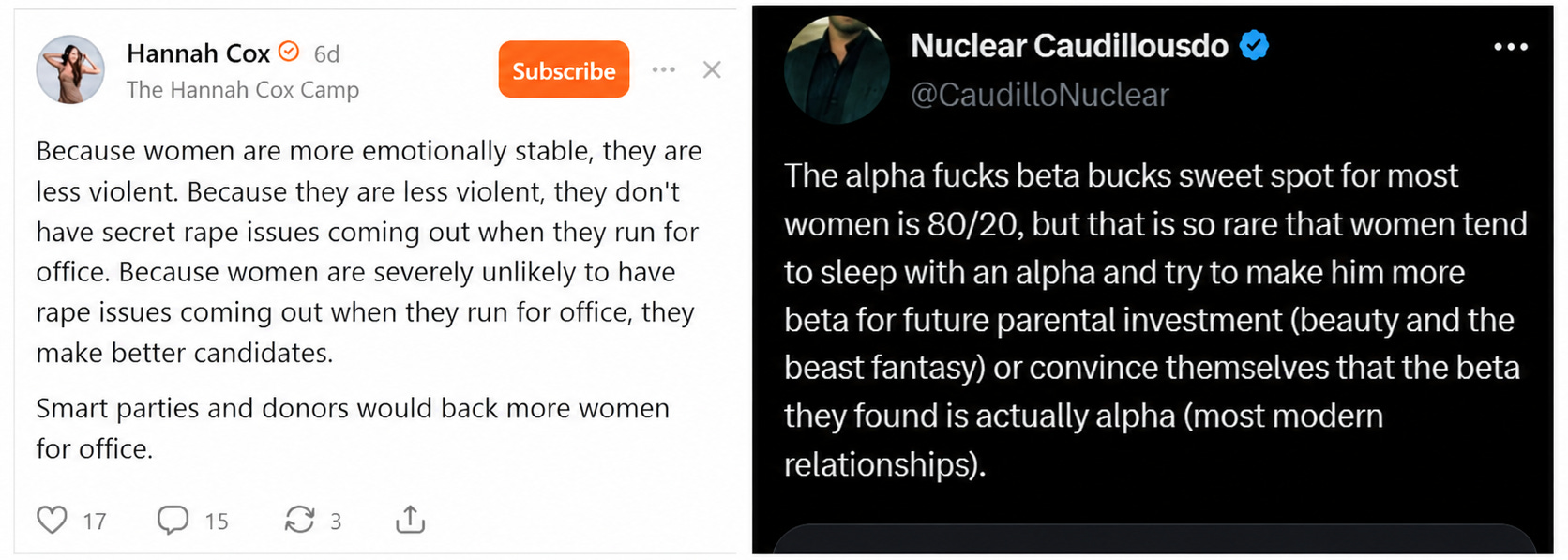
Understanding psychological sex differences helps relationships. It allows one to be less resentful when a member of the opposite sex behaves in a way one finds unreasonable. Maybe one or the other is simply a victim of their own sex-based biases. Perhaps one should even try to reframe some of these disagreements as natural friction between dimorphic traits.
On a more collective level, characterizing online discussions about men and women as “gender slop” is mostly fair. For most people, they function as an entertaining waste of time, much like video games. But they are also the closest thing we have to a public “discourse” that might influence how important cultural institutions approach questions concerning men and women. Those institutions can then shape the culture and influence policies that change the incentive structure, such as the introduction of no-fault divorce in many Western countries.
The basics
I outline some of the differences between men and women that are robust in the academic literature and also underlie many of the more specific differences we observe in interests, choices, and outcomes. Some of those differences are extremely obvious. But rest assured: even if you are a veteran of the online gender wars, there are still some graphs and takes here that you probably have not seen and can reuse in your future keyboard crusades.
People vs things affinity
This is one of the largest gender differences: men are more interested in “things”, while women show more interest in “people”. I consider this fairly obvious, but I provide the studies regardless (1, 2, 3). The main point of contention in the gender wars is not whether differences in interests exist, but to what extent they are innate and to what extent they are induced by the environment, sometimes described as hegemonic patriarchy.
The problem with the “mostly or 100% environment” hypothesis is that cross-country comparisons don’t support this view. Swedish women choose “people” fields such as sociology over “things” fields such as engineering to a greater extent than women in Iran. But Sweden is obviously more egalitarian than Iran. Women in Sweden also have hard incentives, such as special scholarships, to study engineering. This is the well-known “gender-equality paradox,” at least among gender-war veterans.
The answer to this “paradox”, as far as I can tell, is that men and women have significant innate differences, and that a more prosperous and liberal Sweden gives men, and especially women, greater freedom to act on their preferences than Iran does. This pattern is very difficult to reconcile with the view that sex differences are mainly imposed by the hegemonic patriarchy. A similar mechanism reinforces quite a few other known gender differences. I am not making this up, even Google’s AI starts talking about this unprompted!
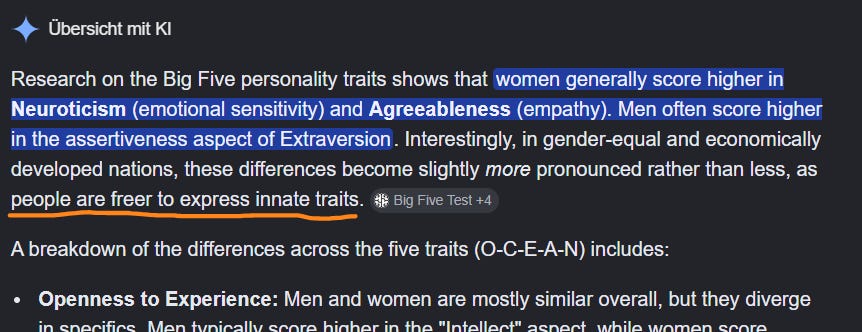
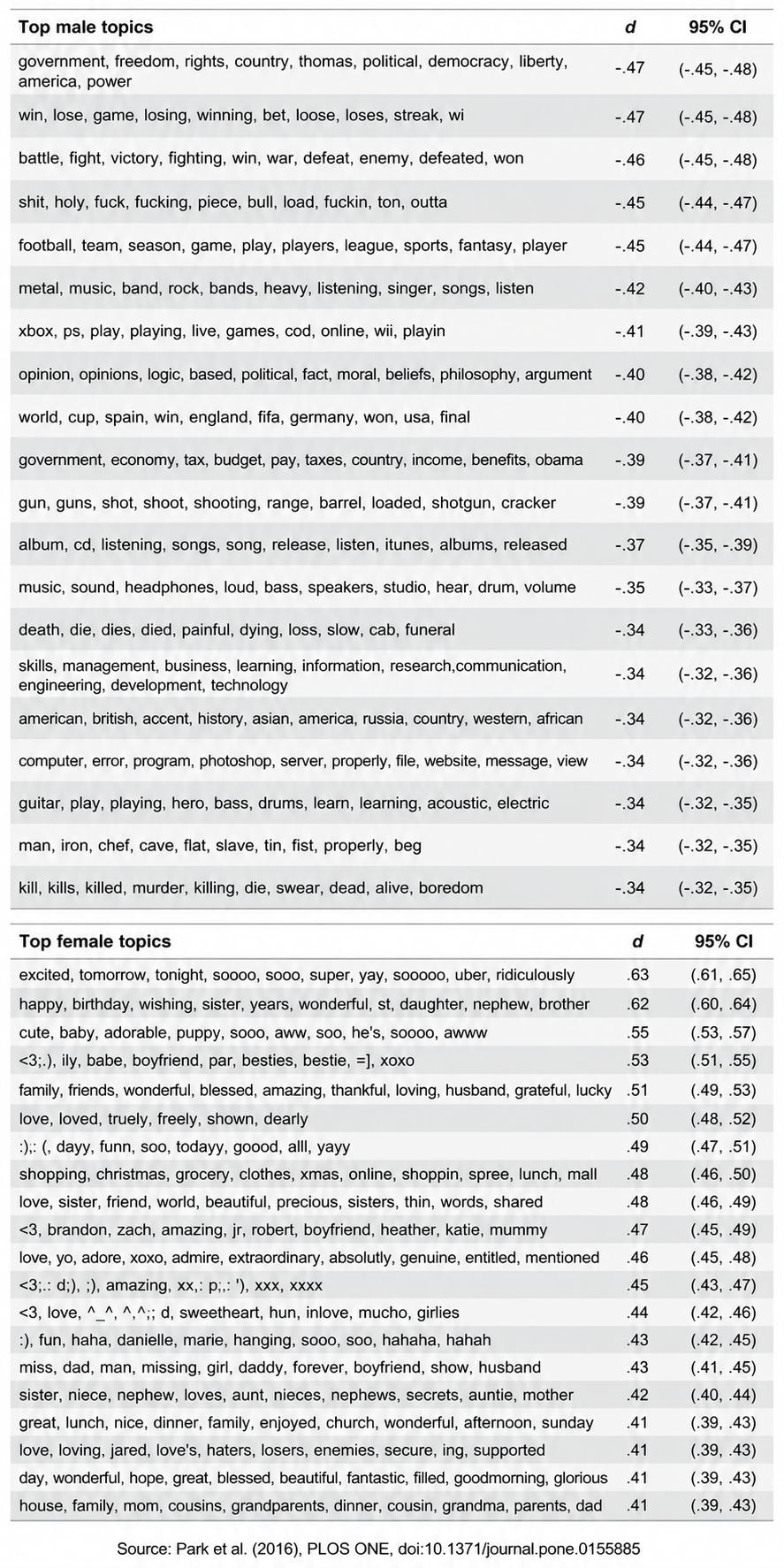
I return to the innate-environmental debate later. To conclude this people-things section, here is a striking illustration of the set of language topics most strongly associated with male and female Facebook users.
Neuroticism, Fearfulness and Risk tolerance
Women are way more neurotic, anxious and fearful than men. This has several implications for survey responses, voting patterns, and individual behaviour.
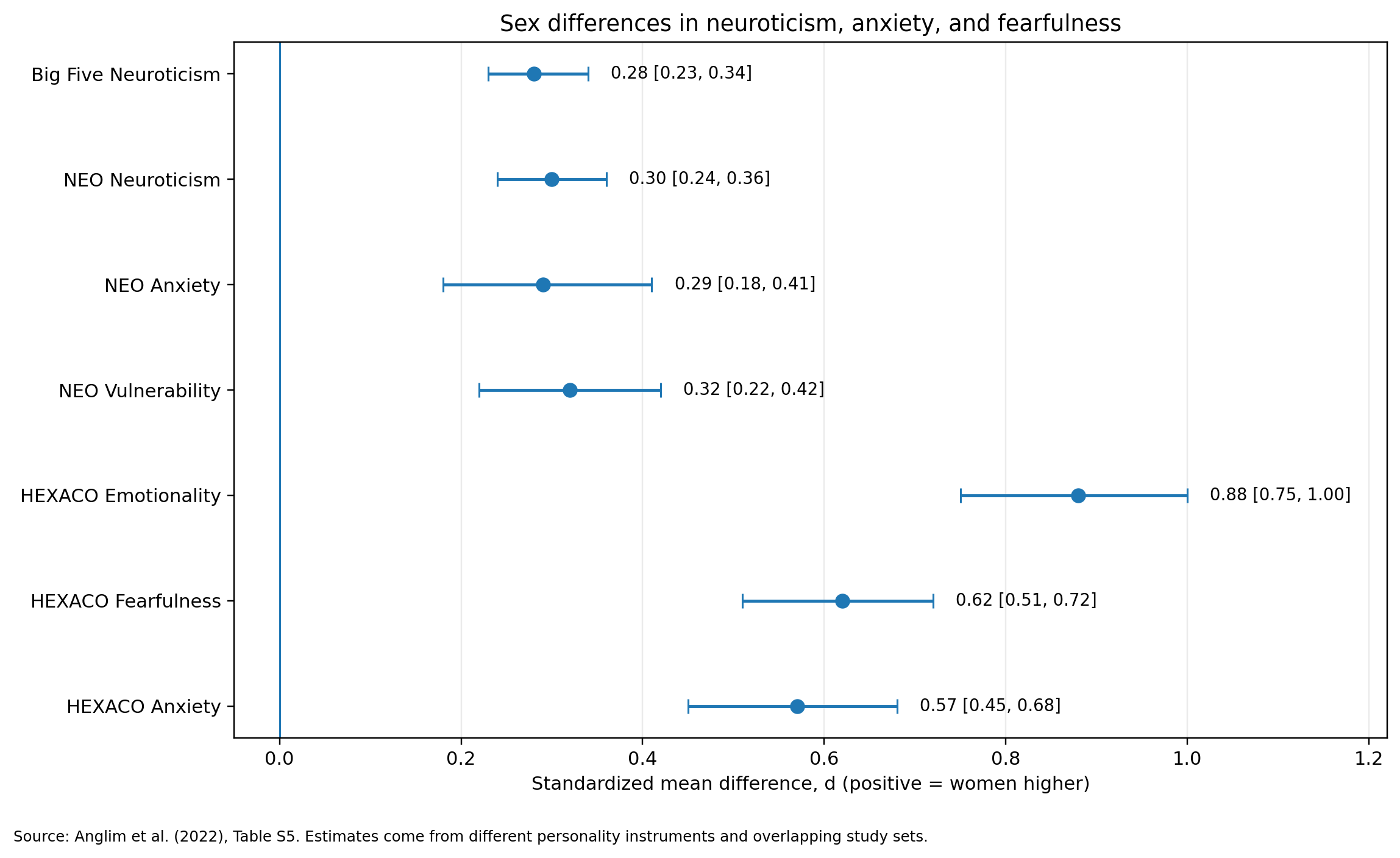
At the individual level, this should be kept in mind to understand some small quirks: Why do men tend to be too comfortable trading shitcoins?2 Why do women tend to place too much value on going to the dermatologist every year?3
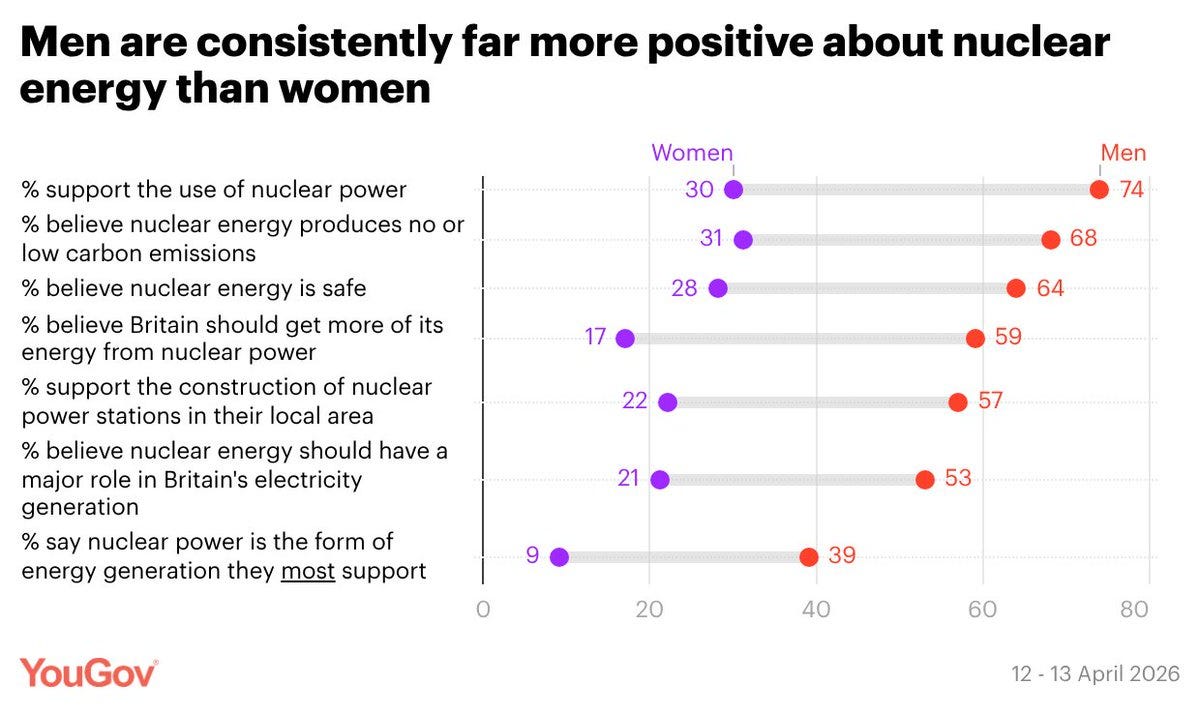
When men and women are polled on specific political issues, the largest gaps are often not found on obviously gendered or polarized questions such as abortion rights, immigration, or the Trans Question. Across countries and over time, support for nuclear energy has consistently produced one of the largest gender gaps found in surveys. Nuclear energy perfectly hits a fundamental difference in how men and women perceive reward and risk, without anything to compensate for it.4 Being anti-immigration is “mean”, but immigrants are also seen as scary and disgusting, which are reactions that women experience more strongly than men on average. Supporting abortion rights is generally perceived as pro-woman, but many women are also religious or have formed a special bond with their baby during pregnancy.
Since risk taking behavior is probably related to fearfulness, I will also mention that men take way more risks than women, whether they are calculated risks or just stupid bets. This partly explains why the founders of successful companies are overwhelmingly male, while men are also more likely to be homeless.
Openness to new ideas and sensitivity to consensus
Men score higher than women on openness to ideas or concepts (1,2).5 The graph below shows how dramatic those differences can be when looking at group averages.
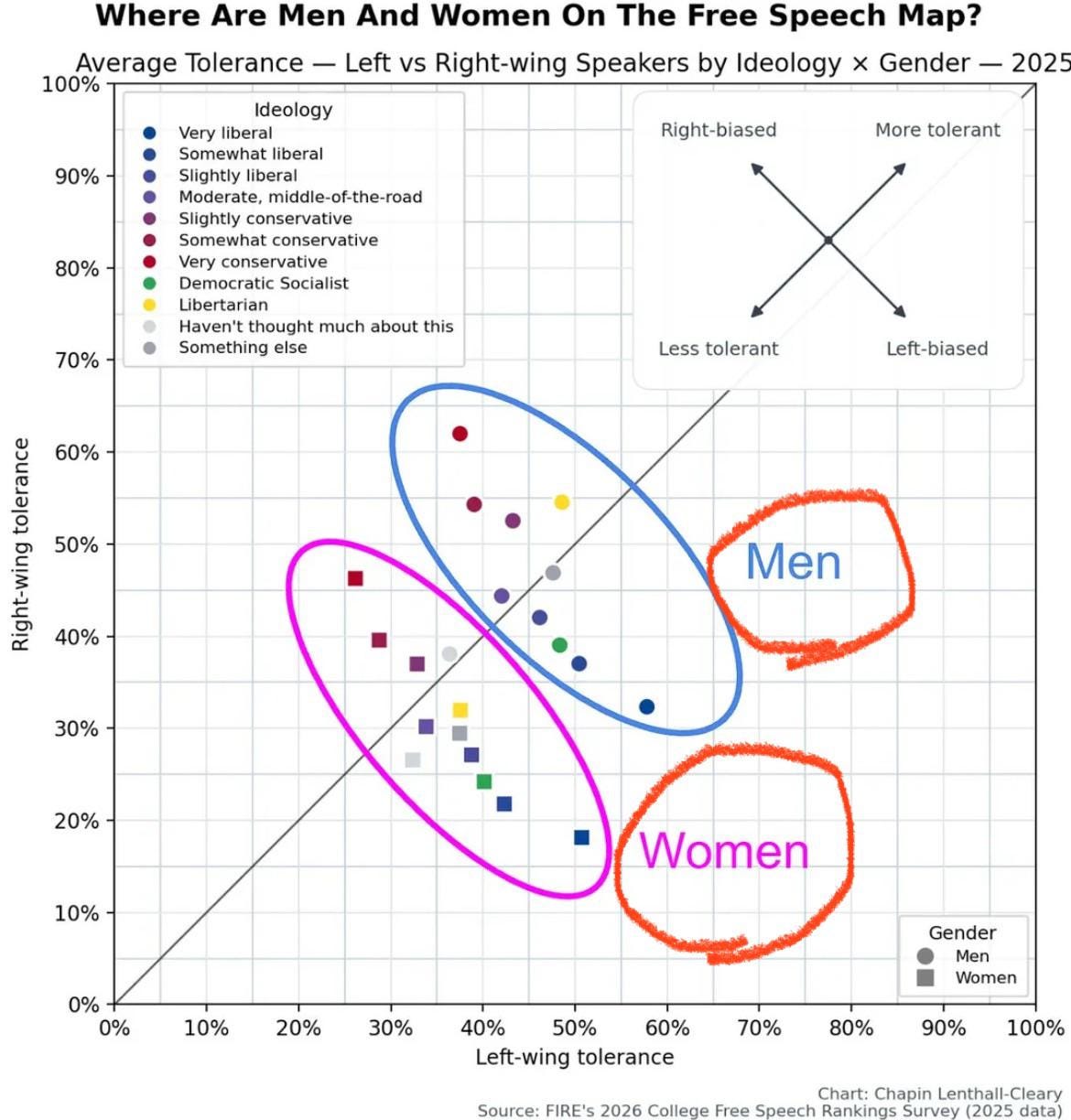
In the FIRE study, sex was a stronger predictor of viewpoint tolerance than ideology. This difference in openness and sensitivity to consensus might be a corollary of women being more agreeable and neurotic than men, rather than a separate phenomenon. But it is still useful to understand on its own, since it has consequences for voting patterns. It is likely that this difference induces some large effects when institutions become female-dominated.6 It also offers practical insights for men interacting with women: in many situations, men have to be a bit more mindful if they do not want to “scare the hoes.” Beyond that, a man should contain his frustration when his girlfriend’s political opinions seem to be a mixture of vibe-based takes and “I don’t know.” Perhaps, he should even try to reframe it as a cute and silly characteristic.
Aggression, violence, crime
This qualifies as an immense difference that colors gender relations and shapes society in fondamental ways.7 Men are way more aggressive, physically violent, and involved in crime. Relatedly, men are way more fascinated by weapons and war than women. So, if you are a woman, do not necessarily start panicking when you see your man playing some scary map game with Nazi flags sprinkled throughout it.
Sexuality and disgust sensitivity
Some boring gender slop that appears too frequently on my feed:
“Women like sex just as much as men, or maybe even more.” or “Women are as sexual, just in different ways!”. These assertions are often justified by pointing out that women read quite degenerate erotic romance novels, the popularity of the sex-and-gossip-oriented podcast Call Her Daddy, or anecdotal experiences. Which is fair if you think this kind of behavior is the peak of degeneracy or sexuality.
The problem is that the term sexuality is a fuzzy term. Whether we look at sociosexuality, sexual openness or libido, men reliably score higher than women (1, 2).8 The largest gap is found in willingness to engage in casual sex or group sex.9 This already makes sense given the psychological profiles outlined in previous sections, but it is also related to higher sexual disgust in women.
And since it is indirectly an important source of gender slop, I will squeeze a last point in here: women have much higher disgust sensitivity across the board. I believe this is one of the main reasons why women, on average, are way more insistent on having a clean house and seem to feel quite a lot of frustration with their male partners, who have lower standards. I am not going to play the marriage counselor and give specific recommendations, but I am going to encourage you to read Lyman Stone’s article about a silly chore-distribution card game.
Navigating the gender slop
Effect of class and age
What often separates correct gender slop from wrong gender slop is whether the “hot take” is correctly aimed at a specified subset of the population or not.10 This is where much of the “alpha” in gender hot takes can be found.
While there are many relevant variables, the following points cover most of the important subgroup subtleties:
Generic “men suck” or “women suck”11 narratives are more applicable to poorer, lower-class, or less intelligent segments of the population
Some of the differences associated with sex hormones attenuate with age. The differences due to accumulated knowledge and life experiences can persist.
The urban–rural and religious–secular divides are real but would take too long to explain here.
Related to the first point, I often see gender grievances from presumably higher-class people who are waging war against the opposite sex over what the bottom 20% are doing. It looks like a proxy war, in which lower-class men and women serve the opposing camp by acting as straw men for their own sex.
Innate differences and accumulation of knowledge
This section is more conjectural, but I think it offers important insights into one of the main sources of gender-slop discourse: biological vs. environmental sex differences.
Innate sex differences in psychological traits may initially be modest, but the accumulation of knowledge and the gradual adjustment of tastes can cause them to snowball into much larger downstream differences over time. People continually make decisions about how they are going to spend their time, and Westerners generally have more leisure time and a greater variety of activities available to them than non-Westerners.12 Small innate differences in tastes and abilities influence how people spend their free time, after which the activities themselves produce further differences in tastes and abilities. This is how a hypothetical boy–girl pair of nerd-adjacent twins could be quite similar at age eight, but by eighteen the boy may have spent thousands of hours playing EU4 while the girl spent thousands of hours reading romance novels. The boy will end up knowing the deep lore of the Ethiopian-Adal War while his sister is unacquainted with the Ottoman Empire. Meanwhile, the girl will have way more references to romantic dramas, novels and shows than her brother. From then on, it is natural that the two will behave and think rather differently, even if they were initially quite similar.
The Environment/Social/Patriarchy factor
This is obviously at least one factor, since some cultures clearly try to emphasize sex differences while others try to suppress them. But strongly social-constructivist views remain popular and tend to attribute close to 100% of the differences to the environment, which is not credible.
Since some sex differences appear very early in life, and are often noticed by parents themselves, the strongest arguments to champion the purely environmental hypothesis focus on differences in how adults treat babies and toddlers. I may be caricaturing it, but the argument often goes something like this: “Adults assumed that the baby wearing pink was a girl and called her cute, while they assumed that the baby wearing blue was a boy and called him strong!” I will let the reader judge whether natural selection or these relatively minor differences in the treatment of infants are the more plausible explanation.
To be fair, a more defensible environmentalist position is that some innate psychological differences may exist on average, but that humans are sufficiently malleable for these differences not to matter very much in practice.
The main problem is that, for decades, Western institutions have been trying to reduce sex differences by expanding freedom of choice, removing certain constraints, and imposing hard bureaucratic requirements on particular outcomes. The overall result is that these efforts arguably worked for the outcomes directly regulated by bureaucratic constraints, produced mixed results where material incentives changed, and failed to produce convergence where freedom of choice was maximized. Obviously, this conclusion comes with all the caveats related to technological changes and their interaction with broader cultural trends. In conclusion, the world seems inconsistent even with the views of the more respectable social constructivists.
Innate biological factors
There is not much to say here. This is a basic result of natural selection. The only question is how much weight is given to it in comparison to the other factors.
I also venture to guess that some psychological differences are due to unsurmountable physiological differences. The main example I have in mind is that a woman grows up knowing that roughly half the population could easily defeat her in a physical fight, and knowing that those men are aware of it too. I imagine that growing up with this knowledge contributes to a more neurotic and fearful disposition, even if one has never been in a fistfight and rarely thinks consciously about violence.
Misinformation
When it comes to gender slop based on misinformation, the main problem is that there is too much of it. The second is that misinformation experts are useless or spread misinformation themselves.
To help with quickly identifying it, I distinguish three types. First, there are some false narratives like the commonly understood gender pay gap or some particularly nonsensical manosphere statistics that we can attribute to the masses often being stupid. I do not have good advice besides encouraging one to try to be more discerning.
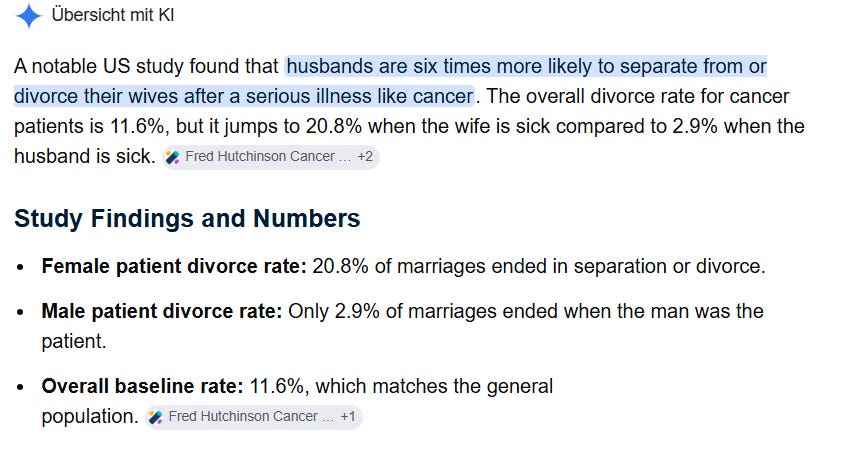
The second type is misinformation for supposedly higher IQ people that uses flawed academic studies. The best way to explain this category is probably to begin with an example: “Men are six times more likely to abandon a wife after she is diagnosed with a serious illness than the reverse.”13
This is particularly egregious because it is very potent outrage porn for women and remains “in the discourse” many years later. The main culprit is the retracted study that conveniently coded attrition or death for men as separation. Other studies examine numerous illnesses or subgroups until a statistically significant difference appears. The corrected study found no statistically significant difference except for one category of disease.
However, most of the study-based misinformation does not use provably wrong research like the previous example. Most often, the dubious studies involve searching for subgroups where the effect is true, playing with the model until a p-value is significant or using bad controls. The typical features of the flawed studies are that they are from psycho-sociology, conclude strong effects from seemingly minor differences in treatment between groups, have relatively small sample sizes and barely significant p-values. They often conveniently support left-wing views. They give off a similar vibe to some of those famous psychology studies of the 1960s.
There is also a manosphere or right-wing variety of study-based misinformation that exaggerates or distorts evolutionary-psychology theories. I am mainly thinking of some of the “dual-mating strategy” narratives.
The final type of misinformation portrays some ancient tribal societies as an egalitarian matriarchal Wakanda. Most often, this egalitarian matriarchal Wakanda was neither egalitarian, nor matriarchal, nor a Wakanda.
Causal relationships between traits
Quite a few times, I may have casually jumped from observing that two traits are correlated to implying a causal direction between them. Or sometimes, I casually link a trait with a specific behavior. For the purpose of navigating gender slop, I do not think this matters very much. It probably matters a bit in debates about innate versus environmental explanations. In practical terms, it often makes little difference whether neuroticism reduces risk tolerance, increasing risk tolerance reduces neuroticism, or some latent variable influences both. The main point is to give the reader a coherent and intuitive comparison of the archetypal psychological profiles of men and women.
Anyway, most importantly, consume gender slop responsibly.
There is some self-deception due to audience capture going on too.
In my opinion, men are probably too comfortable doing that.
Apparently, the expected gain in life expectancy from going to the dermatologist every year vs. never going is at most a few weeks.
Men are significantly more knowledgeable about nuclear energy, so sharing nuclear anti-misinformation articles to close this gap in support is reasonable. But it seems that informing women about nuclear energy and its benefits raises support only up to a point that remains below men’s current level of support (1,2).
I correctly decided that openness to feelings does not count!
There is high gender slop potential here!
Yes, water is wet but it would be weird to not have it on this list.
Water is wet once more.
More info on the specific fetishes can be found, in an entertaining but potentially biased format, here.
And gourmet gender slop is when a take applies collectively to men or women, sounds true, and is something I had never heard before.
Think of cheating, paternity fraud, wife-beating…
The reason the gender-equality paradox manifests itself.
One day, I shall write an article listing all the study-based gender-slop misinformation that I know of.
Great article! The discourse falls into predictable failure modes. In general, differences between men and women are either overstated or understated - and usually are not accurately stated.